A Gojek Clone UK app means having access to transport, food and grocery delivery, and courier services, as well as many other on-demand solutions on one digital platform.
Rather than being a single-purpose taxi or delivery application, this model enables businesses to operate a number of services and generate income from different activities undertaken by their customers.
For the UK market, however, success depends on choosing services that match local demand, building a reliable provider network, and creating a revenue model that remains sustainable as the platform expands.
Building the Right Business Model for the UK
The business model should start with a well-defined service strategy. This means that launching all services at once will lead to high operational complexity and difficulty in acquiring customers. Thus, it is better to develop a strong basic service category and later add complementary service offerings to it.
For example, transportation services can become the first stage, followed by food delivery and grocery services. After the demand and supply get stabilized, there might be added such services like parcel delivery, house maintenance, beauty booking, and others.
This creates a multi-service app in the UK model in which the same customer account can be used across several services. It also gives providers another way to reach customers without requiring separate platforms for every service category.
How the Platform Makes Money
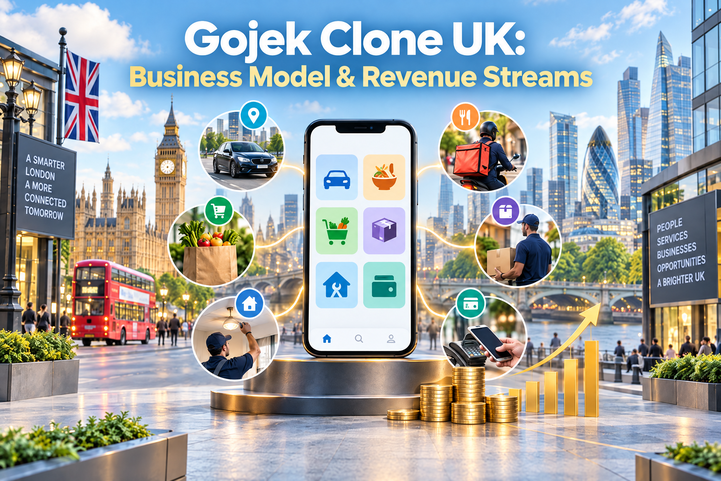
A vital benefit of a Gojek-style business is that the income can be generated from various sources. Various services can adopt different monetization methods based on the costs incurred and the customers’ behaviors.
Take ride-hailing as an example; it can generate income by charging drivers commissions as well as booking fees. On the other hand, food and grocery services may combine provider commissions and delivery fees.
Corporate services can follow contract-based pricing, while premium services can use higher booking charges. This diversified approach gives the Gojek Clone App in the UK several opportunities to generate revenue while reducing dependence on a single service category.
1. Commission From Service Providers
Commission revenue is one of the most popular means of gaining income for a Gojek-like app. The platform can charge drivers, restaurants, vendors, and even service professionals for each completed transaction.
For instance, a ride could produce commission revenue from the driver and/or fleet operator. Likewise, food orders are likely to provide commission revenue from the restaurant. Home service providers could use a similar approach.
The commission percentage can differ from one category to another, as services may have different levels of profit margin, operational costs, and involvement of the platform.
2. Delivery and Convenience Fees
Delivery services can earn income via charges imposed on their clients. Food or grocery delivery, parcels, laundry, etc. may come with delivery fees based on distance, order quantity, urgency, area, and type of service.
The Gojek Clone app development project allows the option to apply flexible fee rules instead of using the same price for every service. This allows the business model to adapt as different categories develop.
3. Dynamic Pricing and Premium Services
Transportation can earn extra income using pricing models in accordance with demand, distance, type of vehicle, time, etc. For example, premium vehicles, airport transportation, scheduled rides, and corporate transport can be charged differently.
The same principle is relevant for other segments as well. For instance, express grocery delivery, urgent mailing services, premium home appointments, or priority ordered services can add to the amount charged.
This allows a super app solution to create higher-value transactions without depending entirely on increasing the number of users.
4. Subscription and Membership Plans
The subscription models may create recurring revenue streams while encouraging customers to utilize new services.
A platform can offer customers the choice of a monthly or yearly subscription, thus providing them with benefits such as reduced delivery costs, discounts on selected rides, priority support, special promotions, and possibly free deliveries over a certain amount of money spent on services or orders.
Provider-side subscriptions should also be considered. Drivers, restaurants, and service providers may also get better exposure, business tools, or lower commission via paid subscriptions.
5. Corporate Accounts
Corporate customers can be recognized as a vital source of income in the UK. Various organizations require transportation, food delivery services, couriers, or regular corporate reservations.
With the help of a dedicated corporate account system, spending limitations, employee profiles, a centralised billing system, regular bookings, and reports can be introduced. The platform can earn money from service charges, corporate packages, commissions, or contracts made via negotiations between the parties.
This can make the on-demand service platform useful for both individual customers and organizations.
6. Advertising and Sponsored Listings
Restaurants, shops, service providers, and other local businesses can pay to have more visibility on the platform.
Sponsored restaurants might feature higher in food search inquiries and grocery shops or other service experts can raise awareness of their special offers. Advertising thus becomes an additional source of income without directly increasing customer costs.
This model works best when promotions are relevant to customer searches and do not affect the process of booking experience.
7. Cancellation, Waiting, and Additional Service Charges
Certain services may entail extra fees in case of cancellations after a driver has already started travelling, waiting delays, additional stops, or certain requests that require some special handling from the provider.
All such fees must be explicitly disclosed and implemented depending on the specified service type. Transparent rules can decrease the number of disputes and help the platform compensate for the expenses resulting from order cancellations or changes.
Choosing Services for a Multi-Service App UK
The best multi-service app development strategy does not require including a plethora of categories in the app. Consideration should be made of the local demand for services, the availability of suppliers, the operational complexity of doing business, competition, and the profitability of each service.
Transport, food delivery services, grocery delivery, courier services, and selected home services can make a great combination to start with. Other services can be added later as they get more customers and supplier activity.
In this way, on-demand app development in the UK becomes less complicated since technology, operations, marketing, and customer support will be scaled according to the demand.
What V3Cube Can Offer Beyond a Standard Market Solution
V3Cube approaches the multi-service model as a broader business ecosystem rather than simply providing a basic clone application.
Its Gojek solution offers more than 101 services comprising specialized panels for customers, providers, shops, administration teams, dispatchers, billing teams, fleet managers, and corporate users.
Plus, several currencies and languages are offered along with options for mobile and web access, booking via WhatsApp and manual dispatch is also available.
Moreover, AI features are also integrated into the platform that cater to business requirements such as dynamic pricing, fraud protection, automated payment report generation, promotional recommendations, booking assistance, and income support for drivers.
These advanced technologies simplify the operators’ work and make the management process easier.
For a Gojek Clone UK Development project, this broader structure can be useful because the business can begin with selected UK services and expand the platform as customer demand grows instead of rebuilding the technology for every new category.
A Practical Revenue Strategy
A new platform doesn’t have to activate every revenue stream in action at the beginning. Commission can be the primary foundation to start with, while delivery fees and booking charges can maintain the operational expenses.
As soon as the customer network grows bigger, subscription services, corporate accounts, premium options, ads, and additional charges can be introduced. This creates several independent revenue channels and reduces dependence on one category.
The long-term objective of super app development in the UK should therefore be to increase the number of useful transactions generated by each active customer while maintaining competitive pricing and reliable service quality.
Final Thoughts
A platform based on Gojek Clone UK can turn into more than just a transportation and delivery service booking. With the help of the right business model, every service type can bring in revenue of its own while sharing common customers, technologies, methods of payment, and operating resources.
The most effective approach would be to start with services that have clear demand in the UK; systematic establishment of reliable provider networks can be followed by the addition of other services. With a scalable Gojek Clone App in the UK, businesses can create an integrated ecosystem for transportation, delivery, commerce, and local services on one platform.
FAQs
Q1. Which services can be included in a Gojek Clone App UK?
Local on-demand categories such as transportation, food delivery, grocery delivery, courier services, home services, beauty, and laundry can be considered for inclusion.
Q2. Is a multi-service app in the UK better than a single-service application?
A multi-service app can create additional revenue owing to the advantage of having several services functioning within one customer ecosystem, although it also requires better operational management.
Q3. Can the revenue model differ between services?
Yes. Transportation, food, grocery, delivery, and home services can use different commission, fee, or pricing models.
Q4. Why is scalability important in Gojek Clone App Development?
Scalability gives an opportunity to introduce new services, customers, providers, revenue models, etc. without having the need to rebuild the whole platform.

Chirag Darji is the CEO of V3Cube, specializing in building on-demand mobile apps and providing mobility solutions for companies around the world. With extensive experience in strategic planning and innovation, he helps entrepreneurs worldwide launch, scale up, and grow successful digital businesses.