Today, businesses are trying to expand their business by selling multi-service offerings in a single app. This growing trend has risen the number of multi-service app solutions we are seeing in the market.
One of the Indonesian companies, Gojek, ensures that super app development takes place with ease. It is true that on-demand multi-service apps have become the norm, which has made Gojek clone apps the much-needed popularity.
However, with this fantastic rise, we see people comparing Gojek clone apps vs. other multi-service app solutions, particularly for startups.
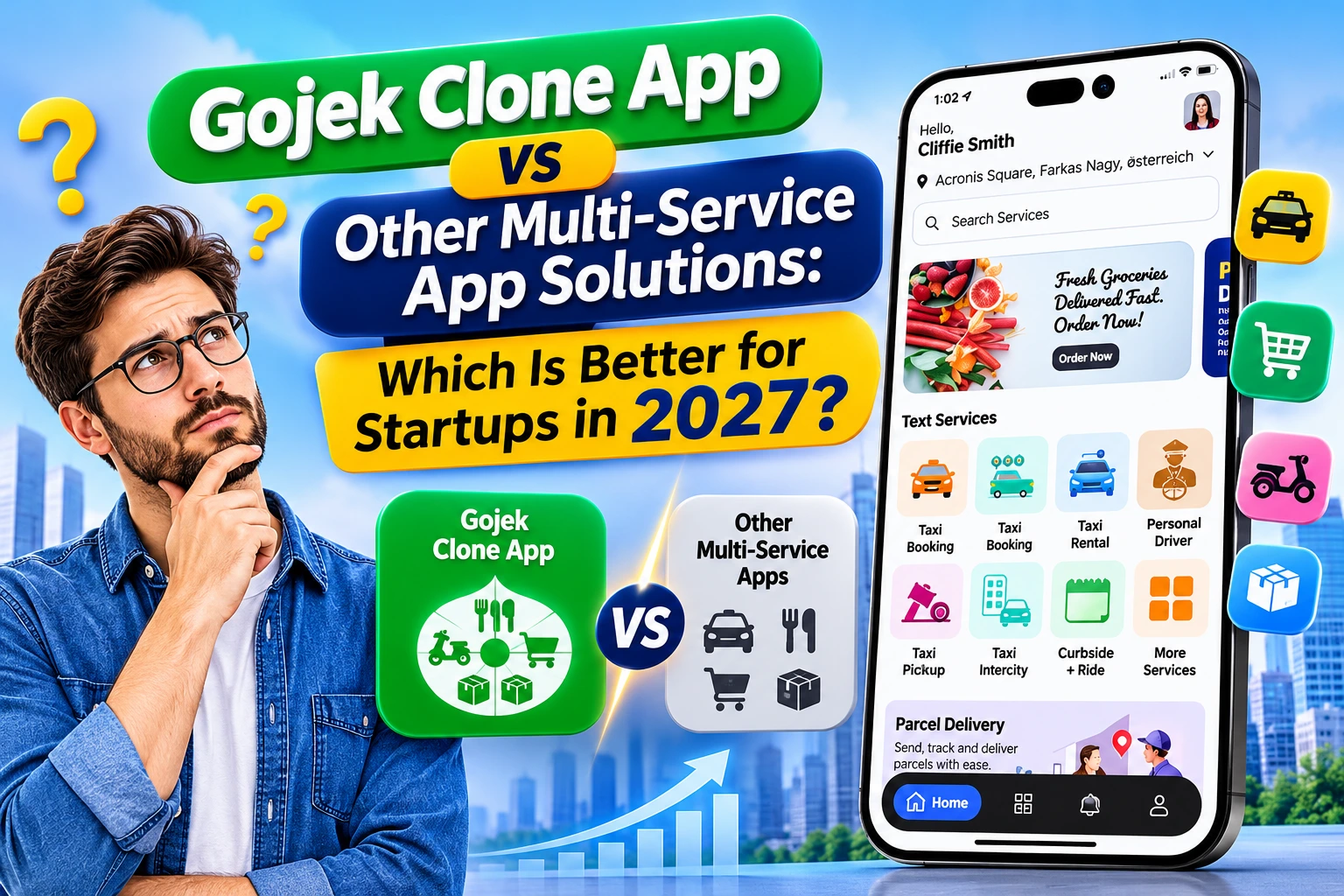
What is the main difference between a Gojek clone app and multi-service app solutions, particularly for startups in 2027?
The basic difference is that a Gojek clone app uses a ready-made script that provides a quick and cost-effective launch, particularly for startups.
Whereas other multi-service app solutions are built from the very beginning. The solutions that you get provide long-term scalability and comprehensive architectural flexibility at a premium cost and a slower timeline.
In this write-up, we will look at the other Gojek clone vs. multi-service app and determine which of the two is better for startups in 2027. Let us begin!
Gojek Clone App vs. Other Multi-Service App Solutions
Let us look at the basic differences between Gojek clone app and other multi-service app solutions.
| Points of Difference | White-Label Gojek Clone Apps | Other Multi-Service Apps |
| Core Philosophy | Broad and provides an all-in-one consumer ecosystem including rides and dozens of local services integrated in the app. | Exclusive and proprietary architecture which is customized to different business models. |
| Time-to-Market | Very swift, about 2 weeks for a fully functional MVP with the help of pre-built frameworks | Extremely slow, about 12 to 18 months, as every API and feature is developed from the very beginning |
| Initial Development Cost | Lower, roughly $35,000 to more than $72,000 contingent upon the modules that are included | High to very high, needing comprehensive engineering teams |
| Customization and Flexibility | Restricted by the base code of the provider because heavy custom code can break updates | Comes with all-inclusive flexibility with total ownership of tech stack, UX, and logic |
| Revenue Touchpoints | Comes with high diversification such as featured listings, multi-vertical balancing, and commissions | Comes with custom-designed monetization engines |
| Scalability | Contingent upon the quality of the script | Fully scalable by design |
| Risk Involved | Lower risk (Tried-and-tested system usage) | Higher risk (New build) |
| UI/UX Design Cost | Low (pre-built template) | High (fully custom design) |
| Feature Development Cost | Included in the package | Fully custom-built as per the requirement |
| Best for | Startups and fast market entry | Enterprises and complex requirements |
Let us discuss each of these options in detail.
Core Philosophy
There was a time when businessmen and entrepreneurs used to opt for single-service apps that had their own flair a couple of years back. However, with the introduction of a Gojek clone app, everything changed over time.
The core philosophy of a Gojek clone app is to offer multi-service offerings in a single app. The services it provides include -
- Taxi booking
- Sending parcels
- Plumber
- Electricians
- Delivery genie and runner
- Online video consultation
- Bidding for services in real time
- Car pool
- Baby-sitter
- Maids
- Cleaners
- Buy, sell, and rent real estate, cars, and general items… and more.
In all, there are more than 108 service offerings that the Gojek clone app provides. This makes its core philosophy very broad. And you end up with an all-in-one consumer ecosystem that includes rides and dozens of local services.
However, ensure that you do not add more than 10 service offerings at a time. The reason for that is that it can confuse your target audience, and they may leave your app.
Whereas other multi-service apps come with an exclusive core philosophy. Its proprietary architecture is customized to different business models.
Time-to-Market
A Gojek clone app uses a ready-made clone script that allows swift development of the multi-service app which can be used as a valid MVP within 2 weeks of time.
This short duration allows businessmen and entrepreneurs who have developed a Gojek clone app to enter the market quickly and create their own user base effectively, as the competition is still under control.
Whereas other multi-service app solutions are very slow. It takes about 12 to 18 months to develop the final product. And its features are also built from scratch.
Initial Development Cost
A Gojek clone app requires a lower initial development cost of between $35,000 and $72,000. The precise cost of development will be contingent upon the modules included.
On the other hand, for other multi-service app offerings, the initial development cost is high to very high because you need to develop the super app from scratch. Hence, it requires a lot of initial development cost.
You may also be required to hire a development team for starting the development process from zero and incur overhead costs of paying salaries, usage of AC, electricity cost, etc. which can lead to an increase in the initial development cost.
Customization and Flexibility
Gojek clone app has limited customization and flexibility, as it is restricted by the base code of the provider. This is where heavy custom code can break updates.
Whereas you can have comprehensive flexibility with other multi-service apps and total ownership of UX, stack, and logic.
Revenue Touchpoints
In a Gojek clone app, there is scope for high diversification in the form of featured listings, multi-service balancing, and commissions. While other multi-service app offerings come with custom-designed monetization engines.
Scalability
The scalability of the Gojek clone app is contingent upon the Gojek clone script quality. While other multi-service app solutions are fully scalable by design.
Risk Involved
Since the Gojek clone app uses tried-and-tested templates, it has lower risk. However, other multi-service app solutions are at a higher risk due to the use of a new build.
UI/UX Design Cost
The UI/UX design cost in a Gojek clone app is very low to moderate since you already have access to pre-built templates. While other multi-service app offerings have a higher UI/UX design cost because you need to develop a fully custom UI/UX design.
Feature Development Cost
As far as the Gojek clone app is concerned, the feature development costs are already covered in the package given by the Gojek clone app development company.
While other multi-service app solutions require fully custom built as per individual needs its cost cannot be covered in the package provided by the multi-service app development company.
Best For
Gojek clone apps are perfect for startups and swift market entry. While other multi-service app solutions are best for enterprises and complex requirements.
Pros and Cons for Startups
Gojek Clone App
Pros
- Quick Validation – It enables you to test and validate all-in-one multi-service apps for startups in weeks rather than the customary years.
- Economical MVP – The MVP of the Gojek clone app can be developed at a fraction of the price of a custom multi-service app development.
- Multiple Revenue Streams – It balances the slump in one service vertical, such as slow rides, with expansion in the other, such as food or grocery delivery.
- Turnkey Infrastructure – The Gojek clone app comes with rider apps, driver/provider apps, and admin dashboards, which are very innovative.
Cons
- Generic UI/UX – Competitors can use a similar white-label script for developing a Gojek clone app, which can make white-label Gojek clone apps seem identical.
- Technical Debt – While you are making use of pre-written code, it can make custom bug-fixing challenging or make profound architectural pivots difficult.
- Feature Bloat – Launching with more than 10 service offerings in a single app can be tempting. However, it can overwhelm first-time users and create the feeling of feature bloat in the Gojek clone app.
Other Multi-Service App Solutions
Pros
- Built from scratch – Other multi-service apps for startups are created specifically for your regional market requirements with scalable microservices such as Flutter, React Native, Node.js, etc.
- Complete ownership of intellectual property – Other multi-service apps provide you with complete ownership rights over the intellectual property and zero dependence on a third-party clone vendor.
Cons
- Sizeable Initial Capital Requirement – There is a sizable capital requirement when you develop a multi-service app, which can prove to be risky before attaining any product-market fit.
Conclusion
All-in-one platforms are the future of business. Hence, if you feel that the demand for a multi-service app such as a Gojek clone is going to decrease, that is not true. In fact, it is only going to rise from here.
The combination of ride-hailing and food delivery is an example of two services that can bring together a wide array of users and create new avenues to generate revenue.
Today, investing in a Gojek clone app is not an upgrade; it is a strategic decision that can help create the next generation of digital platforms.
Multi-service apps are using the super app concept to greater effect and create their own space in the digital sphere.
If you are looking to develop a Gojek clone app with faster time-to-market, choose a reputed Gojek clone app development company such as V3Cube. Our professional team will hear your idea and ensure that it is developed into a fully functional app with a quick time-to-market.
So, what are you waiting for? Contact us today!
FAQs
Define a multi-service app or a super app?
A multi-service or super app integrates several service offerings in a single app. These can include taxi ride booking, grocery and food delivery, and consultations from professionals such as doctors.
Which industries can find a multi-service app a lucrative revenue generation tool?
A multi-service app can be useful for industries like ride-hailing, healthcare, beauty, retail, logistics, and food delivery.
Can a Gojek clone app be customizable?
Absolutely! As businesspeople or entrepreneurs, you can personalize services, payment methods, language options, features, and design to fit specific markets and individual customer needs.

Chirag Darji is the CEO of V3Cube, specializing in building on-demand mobile apps and providing mobility solutions for companies around the world. With extensive experience in strategic planning and innovation, he helps entrepreneurs worldwide launch, scale up, and grow successful digital businesses.