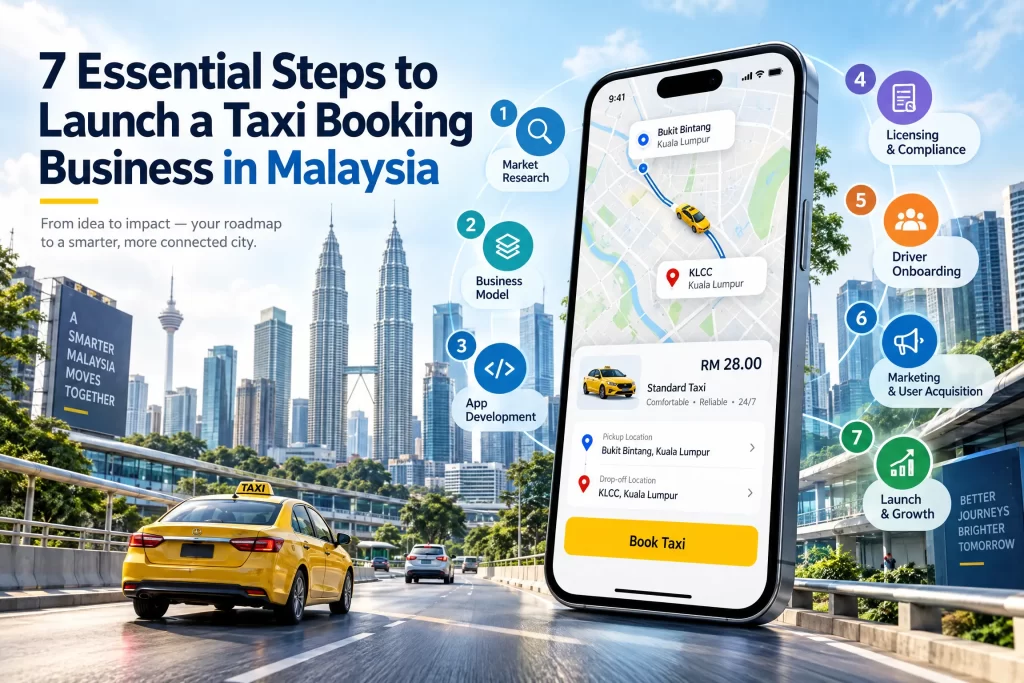
To be successful, a taxi booking app in Malaysia needs much more than just a well-designed user interface and a simple way of booking rides.
In addition to that, it also needs a business model that is adapted to the specificities of local travelers, reliable driver availability, transparent pricing, simple payment options, and a plan for repeat bookings. The real challenge lies in creating a service that will work well for riders as well as drivers and support the commercialization of the business.
Success in the Taxi Booking Business in Malaysia for entrepreneurs lies in the choices made prior to the business being launched and later enhancements.
Taxi app development should be viewed not only as a technical project, but as a complete operating system that oversees driver management, bookings, payments, and relations with riders.
Step 1: Choose a Malaysian Market Where the Service Can Win
The initial decision is not about which features must be created. It is about what genuine transport needs there are.
Kuala Lumpur and the Klang Valley may provide opportunities when it comes to office commuting, airport transfers, shopping trips, and late-night travel. However, there are some other regions that might need different transportation services, including tourism transport, access to local cab services, and scheduled rides between residential colonies and commercial hubs.
A new taxi business in Malaysia should begin its operations by choosing a specific group of riders instead of trying to cater to everyone, all at once. For instance, an operator can provide taxi services for airport transfers, corporate travel, as well as family trips or regular urban travel.
Research should answer three questions:
- When do people struggle to find transport?
- What do existing services fail to provide consistently?
- Which customers are most likely to book repeatedly?
Step 2: Build a Business Model That Works Beyond Individual Rides
A taxi platform has to devise a viable business model that will ensure consistent earnings and help cover operating costs. Just taking a commission from each ride may not be enough in case of driver turnover and other expenses that consume too much income.
Consider the following revenue options:
| Revenue source | How it works |
| Ride commission | The platform retains an agreed percentage of each completed trip. |
| Booking fees | A clearly disclosed service fee is charged for eligible bookings. |
| Corporate accounts | Businesses pay for employee transport through agreed billing arrangements. |
| Premium rides | Higher-value services can carry different pricing structures. |
| Scheduled and airport rides | Pre-booked journeys can support planning and specialised service packages. |
A ride-hailing business in Malaysia must strive to create consistent transactions instead of maximizing profits on every booking. Reasonable commission rates combined with reliable payment processing will help retain drivers while establishing clear pricing principles will attract new riders.
Step 3: Consider Licensing as a Business Requirement, Not a Checkpoint
A polished application cannot compensate for an operation that fails to meet local transport requirements.
The transport authorities of Malaysia are responsible for the governance of e-hailing and taxi operations. The country’s Ministry of Transport explains that e-hailing is defined as an electronic application-based arrangement with public transport and that it is available in all states of Malaysia, including Sabah and Sarawak.
Licensing and requirements for vehicles vary according to the type of operation. The business has to obtain a relevant operator license before entering the market, determine vehicle permits, licenses for drivers, insurance and other requirements to be satisfied.
It is also necessary that the company define policies for the verification of drivers, handling of complaints, reporting incidents, cancellations, and dealing with fare disputes.
Step 4: Design the Taxi App Around the Entire Journey
The quality of a Taxi App Malaysia service is determined by how well the booking works from beginning to end, not by how many features appear in the menu.
A rider should be able to provide pickup point and destination information for the driver, get an estimate of the fare, find out the vehicle type, confirm the booking, and track the driver. After the trip is finished, the platform must also be able to take care of payments, provide receipts, provide ratings, and deal with complaints.
The application for drivers needs to have a different set of functionalities: getting ride requests, navigation, getting trip status updates, tracking earnings, and getting access to important passenger information.
However, the operator has to get a special panel that will allow for tracking bookings, managing drivers, changing the service parameters, and reviewing the transactions.
Good Taxi Booking App Development connects these three experiences through one operating system.
Step 5: Make Booking and Payment Convenient for Local Customers
Riders may stop the booking process if they find booking difficult or if it is unclear what the total cost will be. So, convenience should be incorporated into the overall service from the beginning.
Online taxi booking businesses in Malaysia can provide app-based bookings along with other suitable channels. To illustrate, booking through websites can be helpful for those riders who like to use bigger screens, and using messaging-based booking can eliminate the need to navigate through another app.
What payment methods to adopt depends on the target audience. Depending on the business approach and support of the payment provider, it can be either card payments, compatible digital wallets and online payments, or cash, as per the case.
Prior to confirming their trip, riders need to be informed about price, extra charges, cancellation rules, and the refund policy. Localisation is essential too. Having Malay and English among the languages is beneficial, while more languages can be offered for specific market segments.
While a convenience booking process does not ensure success, needless friction can prevent interest from converting into actual rides booked.
Step 6: Give Drivers a Reason to Stay on the Platform
A taxi business is capable of retaining riders via promotions but very much requires a dependable driver network in order to maintain good service.
The drivers need to be educated on the ride allocation process, the commission policies, payout timelines, and handling of disputes. Vague policies can break trust even in the time of peak booking demands.
The process of recruiting drivers should involve transparent onboarding along with verification, training, and well-defined service standards. Incentives may be linked to completed trips, timely pickups, quality of customer feedback, and fulfillment of trips during peak times if rules are fairly applied and financially viable.
Operational data also needs to be factored into the taxi app development in Malaysia strategy. The number of bookings done is not sufficient. The business must track the number of booking acceptances by drivers, time taken to pick up riders, number of trips completed, customer retention, and revenue after granting incentives.
These measurements enable finding out if the increasing revenues translate into improved business.
Step 7: Use Smarter Technology to Scale Without Losing Control
After bookings become steady, the next task is scaling up without creating operational confusion. Rapid expansion leads to longer pickup times, varying quality of service, and increased customer acquisition cost.
The platform needs to provide the opportunity to grow step-by-step into new service zones, categories of vehicles, corporate transportation, or scheduled rides. Each new service should be proven in terms of its demand, hiring of staff, operational expenses, and profitability before introducing it as a permanent service.
Where V3Cube can offer an advantage
A basic taxi application may cover booking, driver assignment, and payment. V3Cube offers a broader set of taxi-platform capabilities that can help operators reduce manual work and introduce additional booking options.
The solutions offered include AI-enabled fare calculation, dynamic pricing, taxi booking with WhatsApp, fraud detection, and driver payout automation.
WhatsApp booking is important from the perspective of attracting riders, since it creates possibilities for booking rides through the messengers they use, instead of requiring them to download an application specifically for transportation.
An artificial intelligence-based pricing solution is of great help to operators regarding their needs for responding to demand, while fraud monitoring will highlight any suspicious activities for further inspection. Automated earnings reporting can also save time in the process of making driver payments.
These capabilities cannot substitute local market research and licensing procedures, as well as competent management. Their value lies in helping a business run its operations more efficiently as booking volume increases.
Conclusion: Build for Repeat Bookings, Not Just Launch Day
The successful taxi booking business in Malaysia integrates a good grasp of local markets, a financial model, regulatory preparations, the suitable use of technology, good payment options, and skilled drivers.
The best starting point is having a specific market to target and clear rider requirements. Once the service is found to be reliable, it can expand with the help of increased automation and additional booking methods. The aim is not just to create a taxi booking app in Malaysia but to form a reliable transportation business trusted by riders.
The business should watch the demo of the provider’s solution, check what functions are included, verify its customization options and costs, and find out if it fits the operational requirements of the Malaysian operations.
FAQs
Q1. How can a taxi booking business start in Malaysia?
Start by investigating the preferred service area, defining the customer segment, assessing the expenses, obtaining necessary transport permits, employing qualified drivers, and launching a developed booking application.
Q2. What features are important in a Taxi Booking App in Malaysia?
The necessary features include the ability to book a ride, calculate ride fare, track the driver, pay securely, access the ride history, assess the driver’s rating, and manage drivers.
Q3. How does a taxi booking business generate revenue?
Revenue can be earned from ride commissions, booking fees, corporate agreements, and providing top-notch service.
Q4. Is it better to launch across Malaysia immediately?
Not necessarily. It is possible to begin in a particular area and only after that extend the business to other cities and regions.

Chirag Darji is the CEO of V3Cube, specializing in building on-demand mobile apps and providing mobility solutions for companies around the world. With extensive experience in strategic planning and innovation, he helps entrepreneurs worldwide launch, scale up, and grow successful digital businesses.